Good morning, good afternoon, good evening — wherever you’re reading this from on this beautiful planet we call home.
This post might feel a little raw. A little unfiltered. Maybe even a little “ghetto,” as I jokingly call it. But it’s real. And it’s something I’ve been carrying in my heart for a long time.
Today we’re talking about respecting parent boundaries.
Not “respect your mom and dad.”
Not “honor your elders.”
I’m talking about respecting the boundaries of the parents in your life — your friends with kids, your sister, your cousin, your niece twice removed. The parents who trust you with their babies.
Because when you disrespect a parent’s boundaries, you’re not just bending a rule.
You’re undermining their authority.
What Do I Actually Mean?
Let’s say a parent tells you:
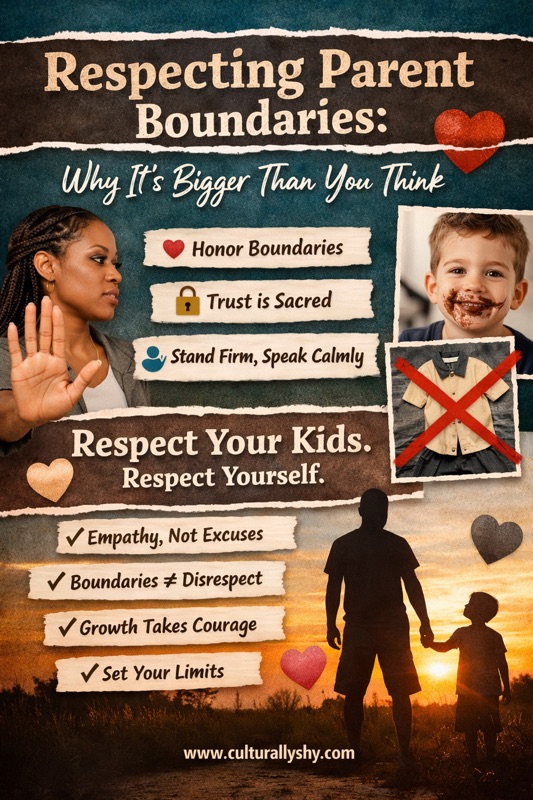
- “Little Timmy doesn’t have candy after 3 p.m.”
- “Please don’t let him play in the sandbox — he eats the sand.”
- “She only eats the snacks I packed.”
- “He thrives on routine.”
Then you return the child covered in chocolate at 6 p.m.
Or with sand in his mouth.
Or you’ve replaced the carefully packed meal with something else because “he’ll be fine.”
You didn’t just “treat” the child.
You showed the parent that you don’t respect their decisions.
And that hits deeper than most people realize.
The Real Issue: It’s Not About the Candy
It’s about trust.
If a parent allows you to take their child out of their sight, they are honoring you with something sacred. That’s not small. That’s not casual.
So when you override their instructions, even if you think it’s harmless, what you’re really saying is:
“I know better than you.”
And sometimes the hardest part?
It’s family doing it.
“It’s just grandma.”
“It’s his favorite aunt.”
“They don’t see them often.”
“I raised kids already.”
Yes. And?
The way you raised your children may not be the way I want to raise mine.
Different generation. Different research. Different realities.
When my son was diagnosed with autism, professionals told me from day one: children on the spectrum thrive in routine. That routine is not random. It’s built through trial, error, money wasted on foods he wouldn’t eat, meltdowns, adjustments, and consistency.
So when I pack specific snacks for him, it’s not me being dramatic.
It’s me doing the work.
The Outfit That Broke Me
After I had my son — during COVID — I was sick, healing slowly from childbirth, and managing my diabetes. I had one specific outfit I didn’t want him to wear because I planned professional pictures in it.
There were 20–30 other outfits available.
I came downstairs one day and he was wearing the one I asked them not to use.
The response?
“You can buy another one.”
“It’s not that serious.”
“He’ll only wear it once.”
The problem wasn’t the fabric.
It was the boundary.
At 24, I handled it immaturely. I muttered under my breath. I was angry. I felt small.
Now at 30, I see it differently.
I wasn’t crazy.
I felt disrespected.
Growth Changes How You Fight
In my younger years, if I felt wronged, you would know. Immediately. Loudly. Boldly.
I’ve been arrested for not knowing how to control my anger. I’m not proud of that, but it’s part of my story.
Now I’m a mother of two. I’ve been parenting for six years. I’m not a professional. I’m learning in real time.
How am I supposed to learn how to parent if everyone keeps overriding my decisions?
At the same time, I don’t want to cut everyone off. I don’t want to shrink my kids’ village. I don’t want to live in constant conflict.
So I’m learning something new:
Calm boundaries.
Not explosive.
Not aggressive.
Not silent resentment either.
Something like:
“I asked that you not use that outfit. When you did it anyway, I felt my boundary wasn’t respected. I need that to not happen again.”
That feels scary. Uncomfortable. Invigorating.
Because I’m not used to standing firm without either exploding or shrinking.
Boundaries Are Self-Respect
This isn’t just about parenting.
It’s about self-respect.
How can we demand respect from others if we constantly abandon ourselves?
I have an endocrinologist appointment coming up. The last time we spoke, he told me I “lack common sense.” A very professional way of saying I’m stupid.
I know I’m not stupid.
So instead of replaying arguments in my head (my therapist calls it future projecting), I’m preparing something calm:
“When you said I lack common sense, that felt insulting. I’m here to learn and work with you, but I need to be spoken to respectfully.”
That’s growth.
That’s choosing where my energy goes.
Empathy — But Not Self-Abandonment
I’ve always been someone who worries about other people before myself.
“They helped me before.”
“They supported me during hard times.”
“They bought my kids things.”
So I let things slide.
I’ve been through eviction. A car accident while pregnant. Parenting a child with autism and another with a physical disability. When help is offered, of course I take it.
But help does not buy access to disrespect.
If you’re going to give and then bring it up later? Don’t give.
And that’s something I’m still learning to say.
Jesus Flipped Tables
I’m on a growth journey. I believe in God. I believe we’re created intentionally.
And Jesus? He wasn’t passive.
When the temple was disrespected, He flipped tables.
Boundaries are not unholy.
They are not rebellious.
They are not disrespectful.
They are necessary.
If God created me, then I deserve respect too.
Teaching My Kids What I’m Learning
My kids are going to make choices.
They’re going to eat crayons or not.
Drink backpack water or not.
Follow friends or not.
I can’t control all of it.
But I can model this:
- Stand firm.
- Speak calmly.
- Respect yourself.
- Don’t let people mistreat you just because you need them.
If I can model that, I’ve done my job.
If You’re Reading This and Feel Like the Black Sheep
I see you.
If you’ve ever felt overlooked.
If you’ve been talked about instead of talked to.
If you don’t have the degree, the money, or the applause.
If your growth isn’t celebrated.
You are still worthy of love.
You are still worthy of respect.
You are still growing.
We are not our past.
We are not our worst moments.
We are not the rumors about us.
We are works in progress.
What I’m Reading & What I Need From You
I’m currently reading Dr. Jekyll and Mr. Hyde. It’s dark. A little slow. But I’m intrigued.
If you have book recommendations with similar psychological or moral depth, send them my way.
And if this post resonated with you, share it.
Not because I’m amazing.
But because maybe someone else needs to feel less alone in this.
Let’s raise our self-esteem.
Let’s model healthy boundaries.
Let’s respect parents.
Let’s respect ourselves.
Keep it locked here at Culturally Shy.