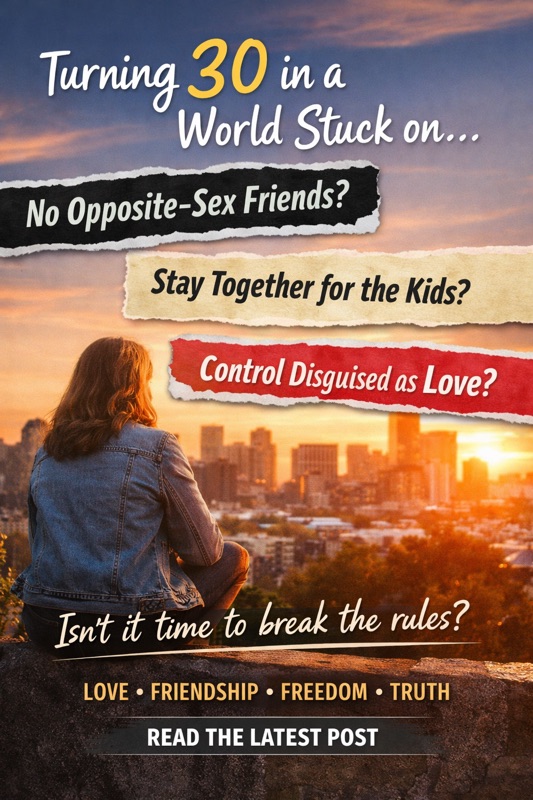
In about 15 days, I’ll be 30.
And honestly? I don’t understand why, heading into 2026, we’re still stuck arguing about whether people in relationships are “allowed” to have friends of the opposite sex.
Somewhere along the way, society decided that commitment means isolation. That once you’re married, dating, or even casually seeing someone, your friendships suddenly become suspicious. If you’re a woman with male friends, the assumption is that something inappropriate must be happening. If you’re a man with female friends, the narrative flips the same way. And if the friend is gay? Then somehow they “don’t count,” as if sexuality determines the value or safety of a friendship.
What is wrong with people?
Relationships Shouldn’t Require Erasing Your Past
Here’s the thing: relationships and friendships are not the same category. They don’t serve the same purpose, and they shouldn’t compete with each other.
What happens when you’ve had friends in your life long before your partner ever existed? Are you really expected to cut them off just because someone else feels uncomfortable? To erase years—sometimes decades—of connection to soothe someone else’s insecurity?
I ask this because a very close friend from my past recently reappeared in my life after two years of complete silence. No explanation. No closure. No way to even know if they were okay.
This was someone I’d known since eighth grade. Someone who, for years, was my first phone call when anything happened. We’d been through ups and downs, including a very brief attempt at dating in high school that lasted all of a week and quickly turned back into friendship. After that, we were just… friends.
So when this person disappeared without a word, it hurt. Deeply.
The Truth Finally Came Out
They called me recently and explained why they vanished.
They found out they were going to become a father. Their partner discovered they had been unfaithful with multiple people. In the process of uncovering those secrets, she learned about the sexual nature of some conversations and encounters between me and him during a time when I was single—and, at times, believed he was too.
The result?
He cut everyone off.
Friends, connections, history—gone. Not because it was healthy. Not because it was right. But because guilt and fear took over. He told me the only friend he still has is one male friend from elementary school… and even that friendship is disliked by his partner.
That’s when I said it out loud:
“So basically, you’re staying in this relationship for the kid.”
And that’s something I fundamentally disagree with.
Staying “For the Kids” Is Not Noble — It’s Harmful
I’ve lived this lesson.
After my second child, I realized something crucial: my kids don’t need a version of me that is silent, shrinking, or people-pleasing. They need the best of me. The honest me. The emotionally healthy me.
Kids learn how to navigate the world by watching us. If they see us swallowing our needs, hiding our voices, and tolerating relationships that drain us, they internalize that as normal.
I don’t want that for my daughter.
I don’t want that for my son, especially as a special-needs individual. I want him to know he can say, “This is what I need. This is what helps me function.” Not, “Let me be quiet so I don’t make anyone uncomfortable.”
If I believed in staying together just for the kids, I’d still be with my first child’s father—a man who taught me firsthand what narcissism looks like. And I refuse to normalize that for the next generation.
Control Isn’t Commitment — It’s a Red Flag
Let’s be clear: if your partner is so insecure that they insist you can only have friends of the same sex, that says more about them than it does about you.
We all wear different masks. Scholars have talked about this for years. You’re not the same person with your kids as you are with your friends. You’re not the same person at a bar as you are at a family gathering. That’s normal.
But when a relationship forces you to wear a mask that hides who you truly are—your friendships, your history, your voice—that’s a problem.
Your partner doesn’t know the you from middle school.
They don’t know the you from high school.
They don’t know the you from the beginning of adulthood.
So why should you have to erase those versions of yourself to make someone else feel secure?
And if you start doing that in relationships, where does it end?
Do you stop being friends with good people because someone else doesn’t like them?
Do you constantly edit yourself for the comfort of others?
That’s not love. That’s control.
I’m Not Doing This in My 30s
When I met my current partner, we agreed to some of these rules. And if I’m being honest, I went along with them because of where I was mentally at the time.
But after losing everything dear to me, I’ve made a decision:
I’m done silencing myself.
I used to get punished for speaking my mind—verbally, emotionally, and worse. I will not carry that into my 30s. I will not teach my kids that love requires self-betrayal.
I’ve blinked, and a whole decade has passed. I’m grateful to be here. I’m grateful to God. But I’m not wasting another 18 years living a life that doesn’t align with who I am.
So I’ll Ask You This…
Do you think these narratives actually benefit us as a society?
Do they create healthier families?
Stronger partnerships?
More secure people?
Or do they just reinforce fear, control, and outdated ideas dressed up as “commitment”?
I’m open to hearing the opposite perspective. I believe in balance. I believe growth comes from challenging our own views.
But I also know this much:
I’m about to be 30, and I’m not playing these games anymore.
Let me know what you think
.
No comments:
Post a Comment